Partager l'article


Although bus service provision has risen up the political agenda, a significant share of the UK population still lacks meaningful access to buses, leaving people dissatisfied and disconnected. The publication of the Department for Transport’s Integrated Transport Strategy indicates a clear commitment to more comprehensive and connected services. However, to move from high-level ambition to action requires a more systematic understanding of current provision: identifying where services exist, where they fall short, and where intervention is most urgently needed. The goal of better services will require a combination of political will and robust analytical frameworks together with a shared understanding of what “good” looks like.
At the webinar “Bus network basics – creating a baseline that boosts economies and promotes resilience”, hosted by Landor Links and sponsored by Padam Mobility, Silviya Barrett from Campaign for Better Transport highlighted a fundamental issue: authorities frequently lack a clear, data-driven understanding of where their networks fail to deliver.

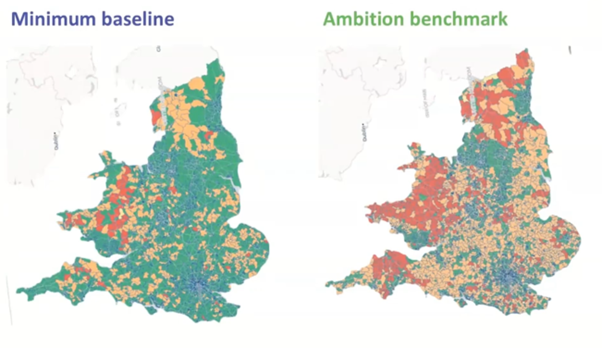
This lack of visibility has real consequences. Without a reliable picture of service provision, communities can remain effectively disconnected, not only from transport networks, but from employment, education, and social opportunities. Campaign for Better Transport partnered with Podaris to develop a Bus Service Standard, designed to systematically assess service levels and highlight gaps across the UK. It is presented as an interactive tool which can be used to understand how well-served by bus services any individual ward is. The approach combines spatial accessibility – whether people can reach a bus stop within a 5–10 minute walk - with service frequency (the best frequency equates to a bus every 12 minutes). Each ward is also classified according to contextual indicators like population density. The standard defines two levels of provision: a minimum standard, representing a baseline level of service, and an ambition standard, reflecting a more advanced, best-practice level of connectivity. The results are striking: approximately 15% of the population live in areas that do not meet even the minimum standard and over 40% live in places that do not meet the ambition benchmark.
While frequency and access are important they are not sufficient on their own. A service only creates real accessibility if it connects people to the destinations they actually need to reach. Network design, travel times, interchange quality, and overall system coherence all play a decisive role. Equally important is how services are perceived. Real-time information, reliability, and ease of use significantly influence whether passengers feel confident using public transport. In some cases, improving information provision may enhance user experience more effectively (and more cost-efficiently) than simply increasing service levels. This reflects a broader shift from measuring inputs (services provided) to evaluating outcomes (opportunities enabled).
Building on these insights, Beate Kubitz compared UK and international examples of fixed bus route design, combining bus stop mapping with frequency indicators. In both cases she mapped how Demand-Responsive Transport (DRT) could increase coverage to communities with very infrequent buses or no bus services at all. However, the success of such systems depends heavily on the use of data analysis and simulation tools. Max McDonald illustrated how solutions such as Padam Mobility can translate these insights into real-world operations. By combining demand aggregation, intelligent routing, and integration with existing transport networks, these platforms allow authorities not only to identify service gaps, but to actively address them, test different operational scenarios, assess trade-offs, and design services that balance efficiency with coverage. Smart DRT offer a pragmatic way to extend coverage and improve access designs in low-density or demand-variable areas.
Several participants sought clarification on how minimum and ambition standards are defined in practice.The Bus Standard Tool has different standards for rural and urban areas – with a lower expectation of frequency in rural areas reflected in the scoring. It was made clear that the tool offers a high level analysis of the availability of transport and the likely need for investment. Other, more complex, tools incorporate accessibility-based metrics, such as the number of jobs or key destinations reachable within a given travel time.
Another set of questions focused on what constitutes an acceptable level of service, particularly in rural contexts. While a two-hourly service may meet a formal minimum threshold, it is often perceived by users as insufficient.The panel highlighted that service attractiveness depends on more than frequency. If routes do not align with real travel needs, increased frequency alone may not significantly boost usage. Conversely, improvements in real-time information and service reliability can substantially enhance user experience.
A couple of questions focused on whether current appraisal approaches adequately reflect the value of bus services. The panel recognised that evaluation frameworks should extend beyond operational economics to include social and environmental outcomes - such as improved access to opportunities, reduced isolation, and environmental benefits. This will be the topic of a future webinar.
Participants also reflected on the institutional structures required to deliver coherent and integrated transport systems. International examples, such as regional transport authorities or coordinated national timetabling systems, were discussed as potential models for improving system performance and user experience.
Several technical questions focused on the data underpinning the analysis. The use of datasets such as BODS and NaPTAN provides a consistent foundation, though limitations remain—for example in relation to geographic granularity which rely on the data available (ward vs parish in this case).Participants emphasised the importance of using up-to-date data and accounting for differences between scheduled and actual service delivery. The ability to test scenarios—such as introducing new routes or stops—was also identified as a key requirement for effective planning.
A number of people wanted to know more about how DRT can be integrated into wider transport systems to complement fixed-route services, enable effective connections with rail, and incorporating DRT into new residential developments from the outset.The panel highlighted how DRT services can be designed flexibly to meet rail services or to ensure that they will not compete directly with fixed bus routes – and how flexible routes can serve new housing easily. They were keen to point out that it can adapt to future changes in travel behaviour, such as those driven by rising fuel costs, and offer tailored services for people with additional mobility, ensuring that system flexibility does not come at the expense of reliability for more vulnerable users.
Building an effective and inclusive bus network requires more than incremental improvements. It demands clearly defined standards, robust data, and a willingness to adopt new approaches and technologies.Most importantly, it requires a shift in focus from the provision of services to the outcomes they enable. Only then can public transport fulfil its role as a driver of accessibility, resilience, and social equity.
.png)