06
/
08
/
2026
Partager l'article


One year after the launch of Yélo Flex in La Rochelle, it is worth looking beyond the technology and asking a different question: what can the public transport industry learn from this project?
Autonomous vehicles continue to generate headlines, yet successful deployment is about far more than introducing a new vehicle. It requires a clear mobility vision, strong operational planning and seamless integration into the wider transport network.
The experience in La Rochelle illustrates that autonomous mobility is most effective when it becomes part of a broader public transport strategy rather than a standalone innovation project. Here are five lessons that other transport authorities and operators can take away.
One of the defining characteristics of Yélo is that it was never designed as an autonomous vehicle project. Instead, La Rochelle developed an integrated mobility ecosystem combining Demand-Responsive Transport (TAD 30–32), door-to-door paratransit (ISIGO), night transport (Yélo la Nuit) and, about a year ago, Yélo Flex within a single operational and digital platform.
Each service fulfils a different role, but together they form one coherent mobility offer. Passengers benefit from a common booking experience, while operators can manage different service types through a single platform. This integrated approach creates flexibility, simplifies operations and allows the network to evolve over time as new mobility solutions emerge.
Technology alone does not create a successful mobility service. Ultimately, passengers judge a service by how easy, reliable and accessible it is to use.
In La Rochelle, considerable effort went into designing the operational side of the service. This included personalised settings for paratransit users, operator training and extensive real-world testing. These elements were just as important as the digital platform itself.
Another key enabler was the Centrale d'Achat du Transport Public (CATP), France's dedicated public transport purchasing body. By providing pre-procured framework agreements, CATP allows transport authorities to access approved suppliers without launching a full procurement procedure for every project. In La Rochelle, this reduced the contracting process to around one month, compared with the six to twelve months often required through conventional public procurement. Faster procurement meant faster implementation, without compromising regulatory compliance.
Perhaps the most important strategic decision was to position autonomous vehicles as a complement to the existing public transport network rather than an alternative to it.
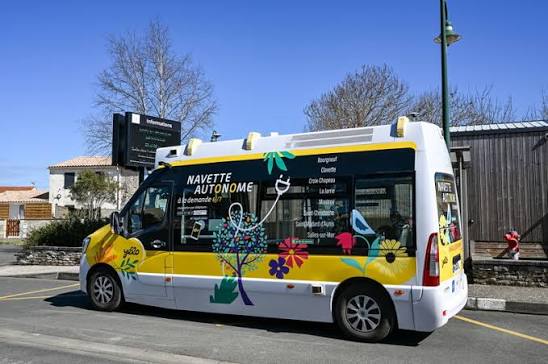
Yélo Flex serves the peri-urban municipalities of Bourgneuf, Clavette, Croix-Chapeau, La Jarrie, Montroy, Saint-Christophe, Saint-Médard-d'Aunis and Salles-sur-Mer, providing transport in areas where conventional fixed-route bus services are less competitive.
During peak periods, vehicles primarily connect passengers with La Jarrie railway station and the Saint-Rogatien Park & Ride, while operating as an on-demand service for local journeys throughout the rest of the day.
Vehicles currently operate with onboard Safety Drivers alongside remote supervision, allowing passengers to become familiar with autonomous mobility while maintaining a high level of operational confidence.
Passengers rarely think in terms of transport modes; they simply want to complete their journey as smoothly as possible.
The Yélo project demonstrates the importance of integrating autonomous mobility into the wider public transport system rather than treating it as a separate service. Booking, payment and customer information are managed through a common platform, while Yélo Flex connects seamlessly with rail services, park-and-ride facilities and the wider Yélo network.
Looking ahead, the planned integration into the regional Modalis MaaS platform will further strengthen this approach, allowing different transport modes to work together as one connected mobility ecosystem.
Perhaps the strongest lesson from La Rochelle is that technology was never the objective; it was the means to address real mobility challenges.
The project focuses on improving accessibility in peri-urban communities, strengthening first- and last-mile connections and supporting La Rochelle's wider Zero Carbon 2040 strategy. Autonomous vehicles were selected because they could contribute to these goals, not because they represented the newest technology.
As more cities begin exploring autonomous mobility, this may prove to be the most important lesson of all. Successful innovation starts by identifying the transport challenge. The technology should follow, not lead, the conversation.
Projects like Yélo Flex suggest that the future of autonomous mobility is unlikely to revolve around standalone robotaxi services. Instead, autonomous vehicles have the potential to become one component of an integrated public transport ecosystem, complementing buses, demand-responsive transport and rail where they add the greatest value.
The question is therefore no longer whether autonomous vehicles will become part of public transport, but rather how they can be integrated in a way that delivers tangible benefits for passengers, operators and transport authorities alike.
.png)