Partager l'article


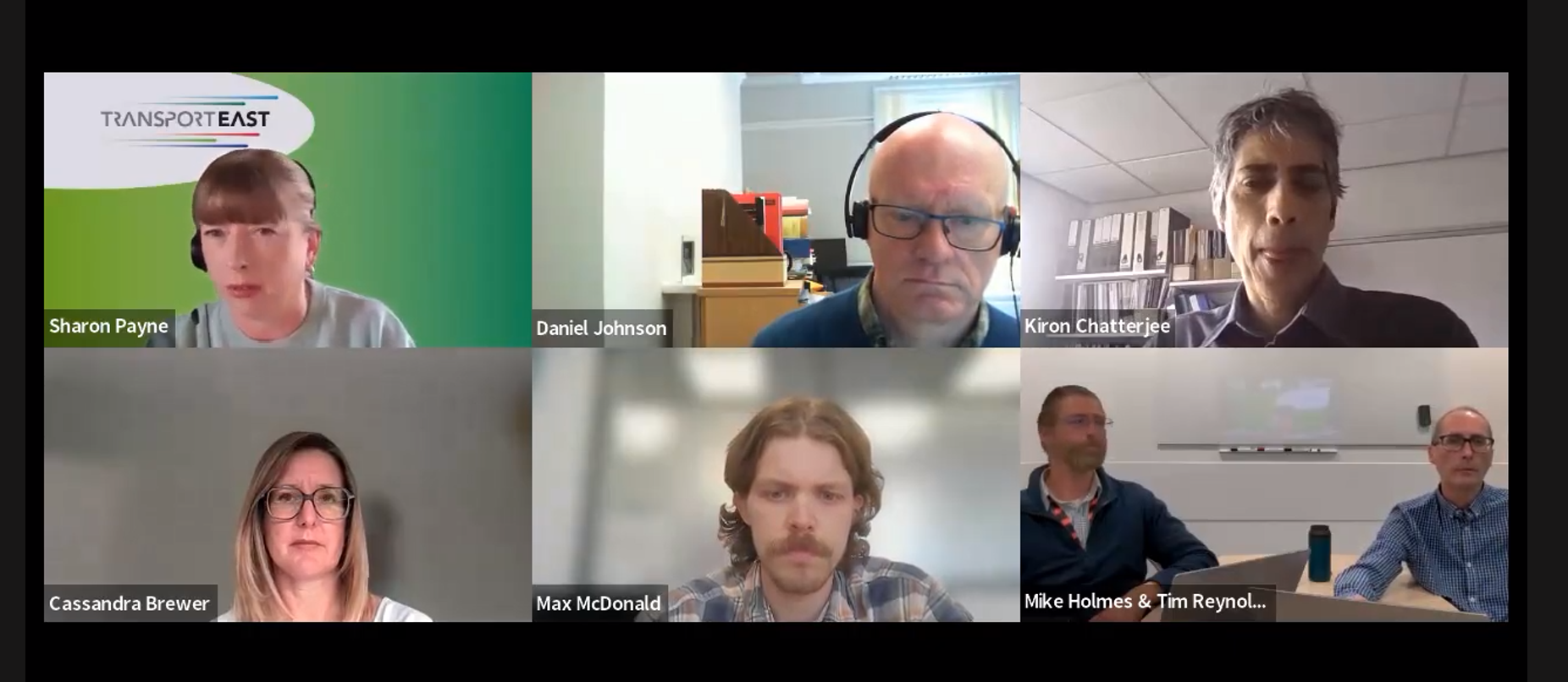
As integrated transport continues to move up the policy agenda, our recent webinar, organised in collaboration with Landor Links, brought together local authorities, consultants, academics and software providers to discuss how rural bus networks and Demand-Responsive Transport (DRT) can work together to improve connectivity.Chaired by Sharon Payne from Transport East, the session explored how rural transport is increasingly moving away from purely fixed-route models towards more integrated and flexible networks.
Cassandra Brewer from Surrey County Council shared practical experience of incorporating DRT into rural services, explaining how flexible transport can complement conventional bus routes and improve access to key destinations and transport hubs.
Mike Holmes and Tim Reynolds from WSP discussed the realities of rural bus franchising, highlighting the potential for designing rural bus networks around connectivity and people’s needs - integrating isolated services - whilst also outlining the operational challenges associated with low-density areas.The wider social and economic value of rural mobility was also a major theme.
Daniel Johnson from the University of Leeds presented an approach to calculating the value of DRT trips based on data collected around in connection with the DRT services launched using the Rural Mobility Fund. This showed the trips which otherwise could not have been made were contributing between £8-18 each to the local economy.
Closing the session, Max McDonald from Padam Mobility explored how DRT can support integrated transport using different designs for particular use cases: feeder services, flexible corridors and connections to rail and bus networks.Throughout the webinar, discussion repeatedly returned to the idea that DRT works best as part of an integrated ecosystem rather than as a standalone replacement for conventional public transport.
How do taxis feature in rural DRT?
There were a number of questions about taxis, the licensing regime (for instance the special operators licence) and the role they could play in rural area transport gaps.
"Taxis are a viable part of the rural transport network and that it is important to retain flexibility in the way contracts are let in rural areas. In some areas however, the demand that local taxis were already facing diminished the interest from companies in participating in DRT travel. Although it varies by local authority, some are spending a lot of money on taxis within the home to school transport budgets. It was pointed out that where there is potential to aggregate these home to school journeys that would increase the availability of local taxis to take on different trips." Mike Holmes, WSP
How does DRT ensure rural connectivity?
It’s increasingly clear that a minimum level of service is required to enable connectivity in rural areas, and the panel were asked about how DRT increased rural connectivity.
"Rural connectivity has emerged as an issue with DEFRA where it is seen as an issue that is not just about transport in isolation. It’s also recognised that DRT facilitates the discussion of rural connectivity as services can go closer to where people live. This is an area in which the conversation about the minimum level of service is ready to start – particularly as there was a mention in the presentation about issues around oversubscribed services. This indicates that there may need to be a scaling up step, however having established the need, we are now at the point where we can start to look at what is needed." Kiron Chatterjee, UWE
"In addition, the move to multi year investments within the context of franchising will make it easier to measure the investment in DRT (and indeed other bus services) against their objectives and outcomes." Mike Holmes, WSP
What are the impacts of journey length uncertainty on trips that connect with onward travel?
There was some interest in whether the uncertainty about arrival times when using DRT (especially as they pick up and drop off people en route) reduces people’s confidence in using them to make rail connections and other onward services.
"People can use the ‘arrive by’ function when booking DRT (at least with the Padam Mobility platform). The algorithm rules then ensure that people arrive by the time allocated by only accepting additional trips in compliance with the ‘arrive by’ rules." Max McDonald, Padam Mobility
Digital exclusion: is it a consideration?
"Digital exclusion was a major consideration in Surrey. Bookings can be made via call centres as well as online and via the app to ensure that as many people as possible can use the service. Interestingly, the app was used for the majority of bookings. The service has reached a very broad cross section of age groups – and marketing aimed at getting young people to use the services paid off." Cassandra Brewer, Surrey CC
"Overall there is still a need for services that take into account very vulnerable people and a cost efficient combination of ‘dial a ride’ style services and DRT is needed." Kiron Chatterjee, UWE
"All the Padam Mobility interfaces are audited to ensure they are in line with accessibility standards and provided by website and call centre software as well as by app. Padam Mobility provides DRT software to manage both traditional public transport DRT as well as paratransit social care and patient transport services and has enabled them to pool resources in some areas." Max McDonald, Padam Mobility
.png)