
Partager l'article


The first two articles in this series set the stage: a European regulation that is still largely theoretical, and three countries,Germany, Norway, and France, each moving at their own pace. One fundamental question remains, which the International Association of Public Transport (UITP) has been insistently raising for several years: what is this innovation really for? To replace public transport in favor of the driverless private car, or to strengthen a shared mobility system that is accessible to everyone?
The UITP has taken a clear stance on this subject for years: the arrival of autonomous vehicles is a unique opportunity to transform urban mobility, but only if public authorities and transport operators keep control of it.
This is the most visible and highly publicized aspect of this transformation. In 2026, several European cities are engaged in a real race for the individual robotaxi.
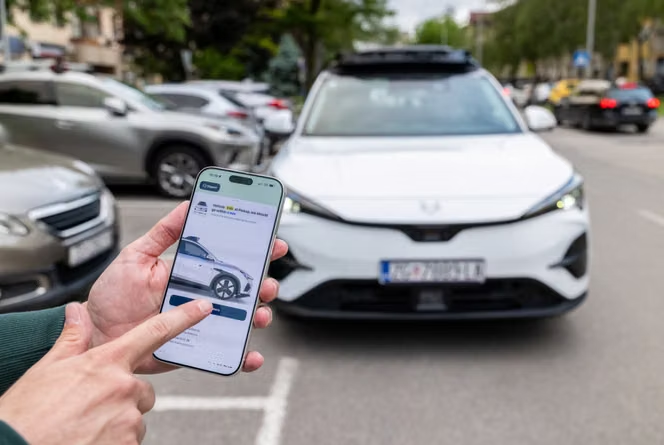
The issue remains clear : an individual robotaxi is still an individual car. Replacing a human driver with an automated system does not reduce the number of vehicles on the road, congestion, or the occupation of public space. Without integration into a shared transport network, automation even risks exacerbating these three problems by making the private car more comfortable and therefore more attractive.
This is the whole point: the shift depends on the public transport sector's ability to embrace this technology before it is built without them.
Faced with this risk, the UITP advocates for another path, that of autonomous vehicles shared and integrated into the existing public transport network.
The question now is how an autonomous shuttle, an automated DRT service, or a driverless bus line can complement the existing offer: serving an underserved suburban area, extending a regular bus line, or providing first/last-mile connections to a station.
This is the goal we champion at Padam Mobility. Our platform remains technologically neutral, designed to connect any autonomous vehicle to the rest of the network : dispatching, supervising, informing, and operating. This independence is what allows us to support transport authorities and operators without locking them into a single manufacturer, and to put our public transport expertise to work for true integration, rather than just a juxtaposition of services.
Three points to remember to conclude this series:
The question that remains is no longer regulatory, but strategic: will the public transport sector seize this innovation before it develops without them?