Partager l'article


The passenger transport sector is one of the most difficult to decarbonize. Today, it accounts for 32% of greenhouse gas emissions in France. It is the only sector where national emissions have not decreased since 1990 and is characterized by a persistent dependence on fossil fuels.
For local authorities and operators alike, proving the ecological virtue of a transport service has become a major challenge. Beyond simply moving passengers, Demand-responsive transport (DRT) possesses massive levers for optimization.
To compare the carbon impact of different goods and services, carbon footprints are calculated using emission factors. An emission factor is the quantity of greenhouse gases (CO2eq) emitted to produce one characteristic unit of a product or service.
To address this, Padam Mobility conducted a Life Cycle Assessment (LCA): for a DRT service using an electric minibus fleet, the result is 52gCO2/passenger-km.
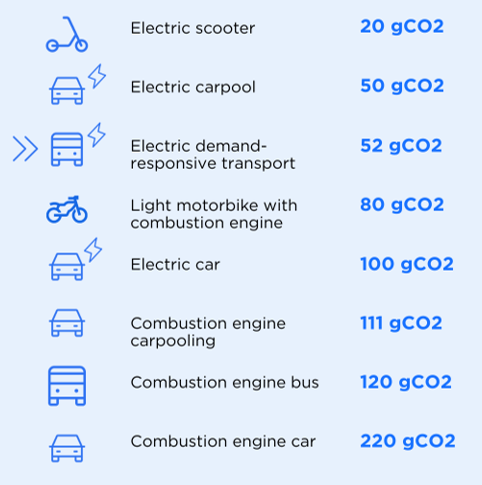
DRT reveals its true potential when analyzing global behavioral changes. The goal is no longer just to measure what DRT emits, but what it prevents from being emitted by asking: "What would this traveler have done without this service?"
Three mechanisms then come into play:
1.The leverage effect on intermodality: DRT acts as a connector. A user traveling 5 km via DRT to reach a station and then traveling 25 km by train avoids a 30 km journey in a private car.
2. The end of the "parental taxi": many users (youth, seniors) rely on a relative for transport. This "chaperone" mode doubles the distance (a return trip with an empty vehicle for the driver). By pooling these needs into an optimized loop, DRT eliminates these "ghost kilometers."
3. Household car reduction: a reliable and efficient DRT service offers a real alternative to owning a second car, sometimes allowing households to sell it entirely.
To act directly on the carbon footprint of a DRT service, authorities and operators have three optimization levers available at a local scale. Padam Mobility supports its partners in implementing these transitions to transform every kilometer driven into an environmental gain.
Padam Mobility’s Consulting team helps you activate these levers through a proven methodology: using precise user surveys, we determine the avoided CO2 emissions and the behavioral changes induced by your service.
*Assumptions for the DRT LCA: Service life: 400,000 km - Battery weight: 90 kWh - Occupancy rate: 1.2 - Electricity consumption: 17.5 kWh/100 km - 2024 France Energy Mix: 22g CO2 / kWh.